
Why Metal Fans Are Wired for Distortion
The air inside the 1970 Birmingham club hung thick with cigarette smoke and the smell of stale beer, creating a heavy atmosphere that matched the weight of the sound vibrating through the floorboards. Black Sabbath took the stage with a grim intensity, pushing their amplifiers to the brink of collapse to create a sonic density that felt more like a physical presence than a musical performance. This was the biology of heavy metal distortion in its rawest form, a sound that pressed against the skin rather than just hitting the ears. Listeners did not merely hear notes, but experienced a violent alteration of the sound wave itself.
A Marshall JTM45, released in 1962, sat at the heart of this revolution, providing the hardware necessary to transform clean signals into something much more aggressive. When a guitarist strikes a string with enough force to drive the signal past the circuit's headroom, the vacuum tubes begin to struggle. The tops of the sound waves, which would normally oscillate in smooth, rounded arcs, start to flatten against the ceiling of the amplifier's voltage capacity. This process, known as waveform clipping, removes the peaks of the audio signal and replaces them with a jagged, compressed texture. It produces a fundamental distortion of reality, turning a melodic pulse into a gritty, unrelenting force.
This flattening of the wave creates a sense of sustained tension that mimics the feeling of an object being crushed under immense pressure. The listener perceives this not as a loss of information, but as an increase in density and aggression. It provides a mechanical grit that serves as the essential foundation for every genre from sludge to thrash. Without this physical degradation of the signal, the music would lack the very teeth that define its character.
The Physics of the Flattened Wave
The physics of distortion relies heavily on the predictable failure of electronic components under stress. In a vintage 1961 Marshall JTM45, the silicon and vacuum tubes react to high-amplitude signals by compressing the dynamic range of the input. As the signal exceeds the amplifier's ability to reproduce the full amplitude, the peaks are truncated, effectively squaring off the sine waves. This square-like shape contains much more harmonic information than a smooth wave, which is why the sound feels so much more complex and thick to the human ear.
The MXR Distortion+ pedal, which arrived in 1978, took this concept and made it portable for the burgeoning punk and proto-metal scenes. Using transistor-based clipping, the pedal creates a distinct harmonic profile that emphasizes a mid-range crunch, providing a sharp, biting edge to the guitar. Unlike the smoother, more rounded clipping found in some tube circuits, the transistor-based approach of the Distortion+ offers a harder, more aggressive edge. It allows a guitarist to cut through a messy mix of drums and bass, even when the overall volume remains relatively low.
Engineers often struggle to balance this aggression with clarity, but they always aim to find that sweet spot where the clipping feels intentional rather than accidental. When the clipping becomes too extreme, the note loses its fundamental pitch and becomes a mere buzz, losing the musicality required to carry a melody. Controlled clipping, however, provides a sense of harmonic richness that feels much more substantial than a clean tone. It represents the difference between a flickering candle and a roaring bonfire, both of a similar light but possessing vastly different physical impacts.
The Biological Rush of the Sonic Threat
The human brain reacts to sudden, high-intensity changes in the environment, a survival mechanism that remains active even when we listen to a studio recording. When a drummer hits a snare with sudden ferocity or a guitarist initiates a massive, distorted chord, the amygdala processes these non-periodic, high-intensity signals as potential threats. In a natural setting, such a sound might signal a predator or a collapsing structure, triggering an immediate physiological response. Within the safe context of a concert or a pair of headphones, this threat response redirects into a state of intense aesthetic pleasure.

This redirection makes the concept of musical frisson vital to understanding the metal experience. Frisson refers to the sudden chills or skin orgasms that occur during moments of intense musical tension, often triggered by unexpected harmonic crescendos or sudden shifts in volume. Neurobiological studies show that these moments trigger massive dopamine spikes in the brain's striatum, the same reward center activated by food or other intense stimuli. The brain experiences a moment of high-stakes tension followed by a release, creating a physiological loop of stress and reward.
The sensation often accompanies a feeling of being overwhelmed, a sensation that heavy metal fans actively seek out. It provides a controlled way to even experience the physiological symptoms of fear and excitement without any actual danger present. This is why the heaviest parts of a single, where the distortion is at its most saturated and the drums at their most punishing, often feel the most rewarding. We essentially hijack our own survival instincts to produce a sense of euphoria.
"I want to create a sound that is heavy, not just in volume, but in the way it feels like it's pressing against you."
The heavy, tactile nature of the music relies on the listener's ability to find pleasure in the simulated chaos of the sound. When the music reaches a peak, the brain's response to the perceived sonic threat drives the intense emotional connection characteristic of the genre. It creates a visceral, biological feedback loop that connects the listener directly to the frequency of the music.
How Iommi Changed the Frequency Spectrum
Tony Iommi's approach to the electric guitar changed the DNA of heavy metal, though his innovation grew from necessity rather than a desire for sonic experimentation. Following a factory accident in Birmingham that resulted in severe injuries to his fingertips, Iommi could no longer play with the tension required for standard guitar setups. To compensate, he began using much heavier gauge strings and down-tuning his Gibson SG, a move that fundamentally altered the frequency spectrum of Black Sabbath's early 1970s output. This lowered the fundamental frequency of the riffs, pushing the music into a deeper, more ominous territory.

This shift in tuning allowed for a massive, resonant low-end that became the blueprint for doom and sludge metal. By reducing the tension on the strings, Iommi achieved a thicker, more sluggish tone that emphasized the low-frequency energy of the instrument. The notes did not just ring, they hung in the air, vibrating with a weight that felt much larger than the physical size of the guitar would suggest. This new frequency profile provided the darkness that defined the early Black and heavy metal albums like Black Sabbath (1970).
The impact of this change provided the harmonic space for the distortion to bloom. A higher-tuned, cleaner guitar lacks the physical mass to support the heavy, saturated tones that define the genre. Iommi's heavier strings interacted with the amplifier's clipping in a way that emphasized the lower harmonics, creating a sense of immense, crushing weight. This created a new sonic vocabulary, one that relied on the physical properties of the instrument to communicate dread.
The Warmth of Even-Order Harmonics
When we describe an analog overdrive as "warm," we describe a specific psychoacoustic phenomenon involving even-order harmonics. In the circuitry of a tube amplifier, the clipping process produces a series of overtones that are mathematically related to the fundamental frequency in a way that the brain perceives as consonant. These even-order harmonics, specifically the second and fourth harmonics, add a layer of richness that feels much more natural and pleasing to the human ear than the harsh, mathematically unpleasant odd-order harmonics produced by some digital models. This presence of musically consonant overtones creates a sense of depth and texture that defines the analog sound.
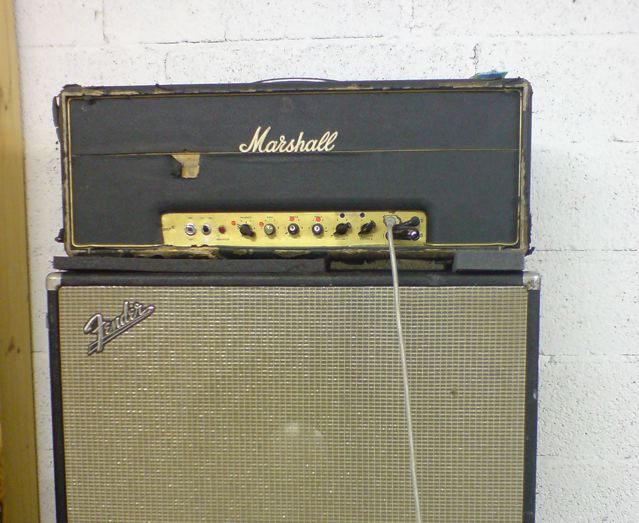
The brain interprets this harmonic complexity as a form of smoothness, or warmth, because the overtones reinforce the fundamental note rather than clashing with it. This explains why a vintage Marshall or a cranked Vox AC3 and can sound much more musical than a clean, sterile digital preset. The distortion does not just add noise, it adds a structured, harmonic architecture to every note played. It fills the frequency spectrum with a sense of completeness that feels physically satisfying.
This makes the distortion in heavy metal feel more organic than the aggressive, jagged tones found in some industrial or electronic genres. The even-order harmonics provide a glue that binds the various elements of the mix together, even when the guitars play extremely complex or dissonant riffs. It creates a sonic cushion that allows the listener to endure high levels of volume and intensity without experiencing total ear fatigue. The warmth provides the necessary counterbalance to the aggression of the fundamental attack.
The Fletcher-Munson Effect and Guitar Bite
The human ear does not perceive all frequencies with equal sensitivity, a fact that becomes incredibly important as volume increases. The Fletcher-Munson curves illustrate how our perception of frequency changes based on the decibel level of the sound, specifically noting that our sensitivity to the 2kHz to 5kHz range increases as we turn the volume up. This specific frequency range is where the "bite" and "presence" of a guitar live, and it is also where the human ear is most sensitive to sharp, piercing sounds. As a metal performance gets louder, the guitars seem to become sharper, more aggressive, and more biting, even if the actual EQ remains unchanged.
This effect explains why a heavy metal concert feels much more intense than a quiet listening session at home. As the decibel levels rise, the mid-range frequencies of the distorted guitars begin to dominate the listener's perception, cutting through the drums and bass with newfound ferocity. The "bite" of the guitar becomes more pronounced, making the music feel more visceral and immediate. It triggers a physiological shift that makes the music feel like it is physically attacking the listener.
Engineers must remain careful with the mid-range when producing heavy albums. If there is too much energy in the 2kHz to 5kHz range, the guitars can become physically painful to listen to at high volumes, leading to rapid ear fatigue. If there is too little, the guitars will disappear into the mix, losing the very "bite" that makes them effective. Mastering this balance differentiates a legendary record from an unlistenable mess.
Engineering the Wall of Sound
The production of Metallica's Master of Puppets (1986) serves as a masterclass in creating a dense, saturated "wall of sound" through careful engineering. Working with producers who understood the power of layering, the album features multiple tracks of heavily distorted guitars, each carefully placed to fill a different part of the frequency spectrum. This technique, which involves doubling or even quadruplicating guitar parts, creates a texture so thick that it feels almost solid. The result is a sonic density that provides the foundation for the album's legendary aggression.

This density relies on the way the frequencies interact with one another rather than simple quantity. By layering different takes, the engineers captured subtle variations in the distortion and the attack, which prevented the guitars from sounding like a single, flat mono signal. This layering creates a sense of movement and depth, even within the crushing weight of the riffs. The guitars do not just sit on top of the mix, they weave into the very fabric of the drums and bass to create a singular, unstoppable force.
Genres like sludge and doom metal, such as Electric Wizard's Dopethrone (2000), utilize low-frequency resonance below 60Hz to impact the body's tactile and vestibular systems. At these frequencies, the sound is no longer just something you hear, it is something you feel in your chest and your bones. The vibration of the sub-bass interacts with the physical structures of the body, creating a sense of immense, crushing weight that mirrors the musical themes of the genre. This provides the ultimate expression of the heavy metal philosophy: a sound that is not merely heard, but physically inhabited.